Ground-Mounted Solar Farms, 1–10 MWp, for Industrial Estates
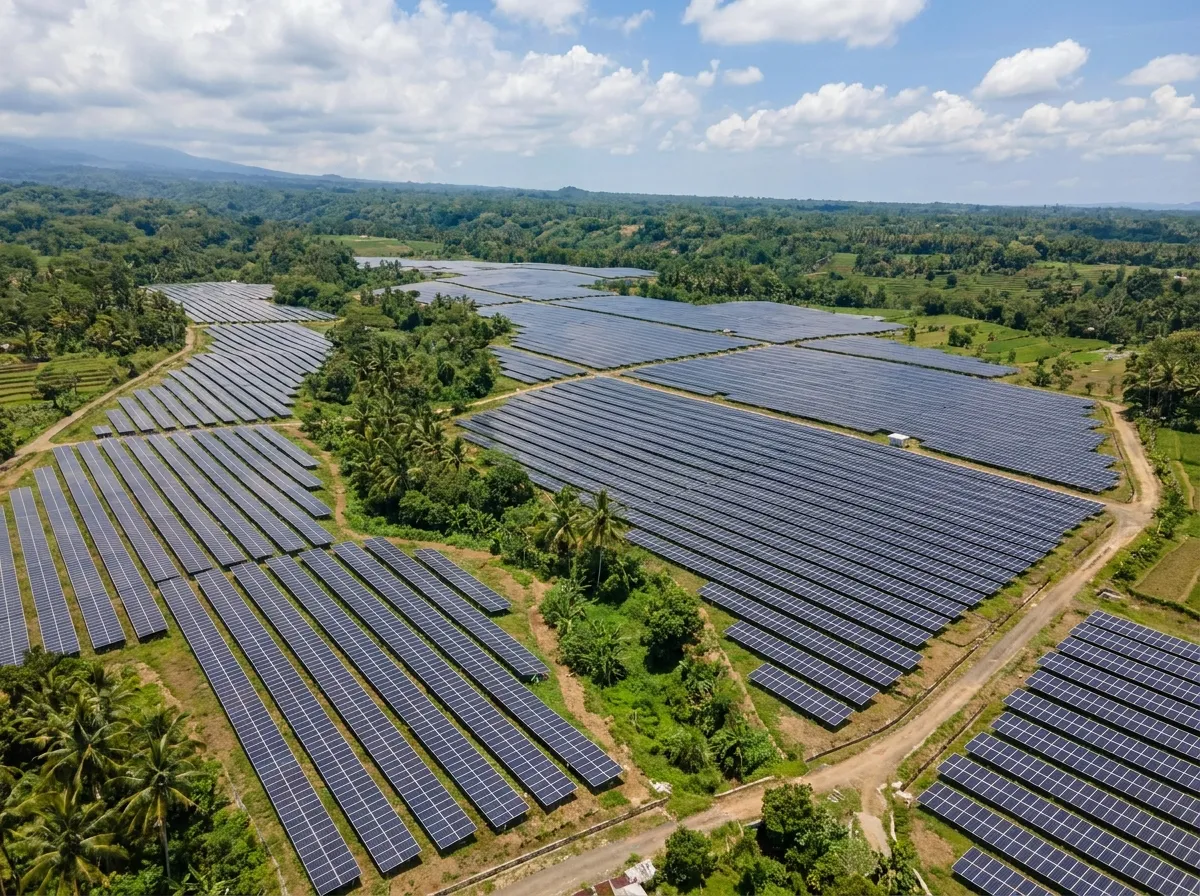
We design and build 1–10 MWp ground-mounted solar plants on vacant factory land and industrial estates in Indonesia — from soil testing and foundation design, hot-dip galvanised structures, tier-1 modules and inverters to grid connection, PLN approval and SLO under one EPC contract. Send your location and land area on WhatsApp and we reply with an estimated capacity, annual yield and cost range.
Ground mounting is the answer when the factory roof is full or too weak but there is unused land inside the fence. Tilt and orientation can be set for best yield, maintenance access is easy, and at larger capacities a central-inverter layout gives the lowest cost per kWp.
Land needed per MWp
As a rule of thumb, 1 MWp of ground-mounted solar needs about 1–1.5 hectares. The spread comes from row spacing (so front rows don't shade back rows in the morning and afternoon), access roads for maintenance, and space for inverters, transformers and drainage.
| Capacity | Approx. land | Annual yield |
|---|---|---|
| 1 MWp | 1–1.5 ha | 1,300–1,500 MWh |
| 3 MWp | 3–4.5 ha | 3,900–4,500 MWh |
| 5 MWp | 5–7.5 ha | 6,500–7,500 MWh |
| 10 MWp | 10–15 ha | 13,000–15,000 MWh |
The land does not have to be one block: several plots inside the factory fence can feed one system as long as the cable route to the connection point makes sense. Filled ground, flood-prone areas and soft soil are usable too — the consequence shows up in the foundation choice.
Foundations: driven piles vs concrete
The foundation type follows the soil investigation (CPT/sondir and, where needed, on-site pile pull-out tests) and is one of the biggest cost and schedule items.
- Driven steel piles or ground screws — installed without concrete, fastest to build with almost no earthworks. Suited to clay and dense sand.
- Concrete foundations (bored piles or cast footings) — for soft soil, fill or rocky ground that cannot be piled. Slower, because concrete needs time to cure.
- Ballast blocks — for land that must not be excavated, such as over a sealed layer; requires careful wind-load design.
Galvanised structures and tilt angle
Structures are hot-dip galvanised steel to resist tropical and coastal corrosion. Because Indonesia sits close to the equator, module tilt is low — typically around 10–15°, facing north for sites south of the equator — which is enough for good yield and helps rain wash off dust. The lower edge height is set by the design flood level and vegetation control; on flood-prone land the modules sit above the highest expected water level.
Price per kWp for ground-mount
2026 indicative benchmark, including tier-1 modules, inverters, structures, standard foundations, cabling, commissioning and PLN permitting:
| System | Type | Indicative price |
|---|---|---|
| Ground-mount 1–3 MWp | Turnkey EPC | IDR 9–10.5 M / kWp |
| Ground-mount 3–10 MWp | Turnkey EPC | IDR 8.5–10 M / kWp |
| Feasibility + design | Per project | Per scope |
Indicative — firm figures after soil testing and land survey.
Example: a 2 MWp system lands at roughly IDR 18–21 billion. What moves the number most: soil conditions (piles vs concrete), earthworks and drainage, perimeter fencing, and the distance from the land to the connection point — long medium-voltage cable runs and step-up transformers are priced separately. Typical payback is 6–9 years depending on the tariff and how much of the energy is used on site. Full size-based pricing is on our solar pricing page.
PLN permits and grid connection
A ground-mounted plant on factory land for own use is treated as a captive power plant running in parallel with the PLN grid. It typically needs PLN approval for parallel operation, an SLO (certificate of operational worthiness) before start-up and, for larger capacities, a captive power business licence (IUPTLS). We confirm the exact requirements during the feasibility study, because they shape the protection design, export control (usually zero-export) and the schedule. Technical documents and SLO are part of our EPC scope.
Scope and schedule
- Land survey, soil testing and foundation design.
- Galvanised-steel mounting structures at optimal tilt.
- Tier-1 modules, central or string inverters, step-up transformer and grid connection.
- Access roads, drainage, fencing and SCADA.
MWp-scale ground-mount projects usually take 3–8 months from design to commissioning. O&M covers module cleaning, vegetation control and structural inspection. We are active in the Karawang, Cikarang and Semarang industrial estates.