Commercial Rooftop Solar Panels in Indonesia
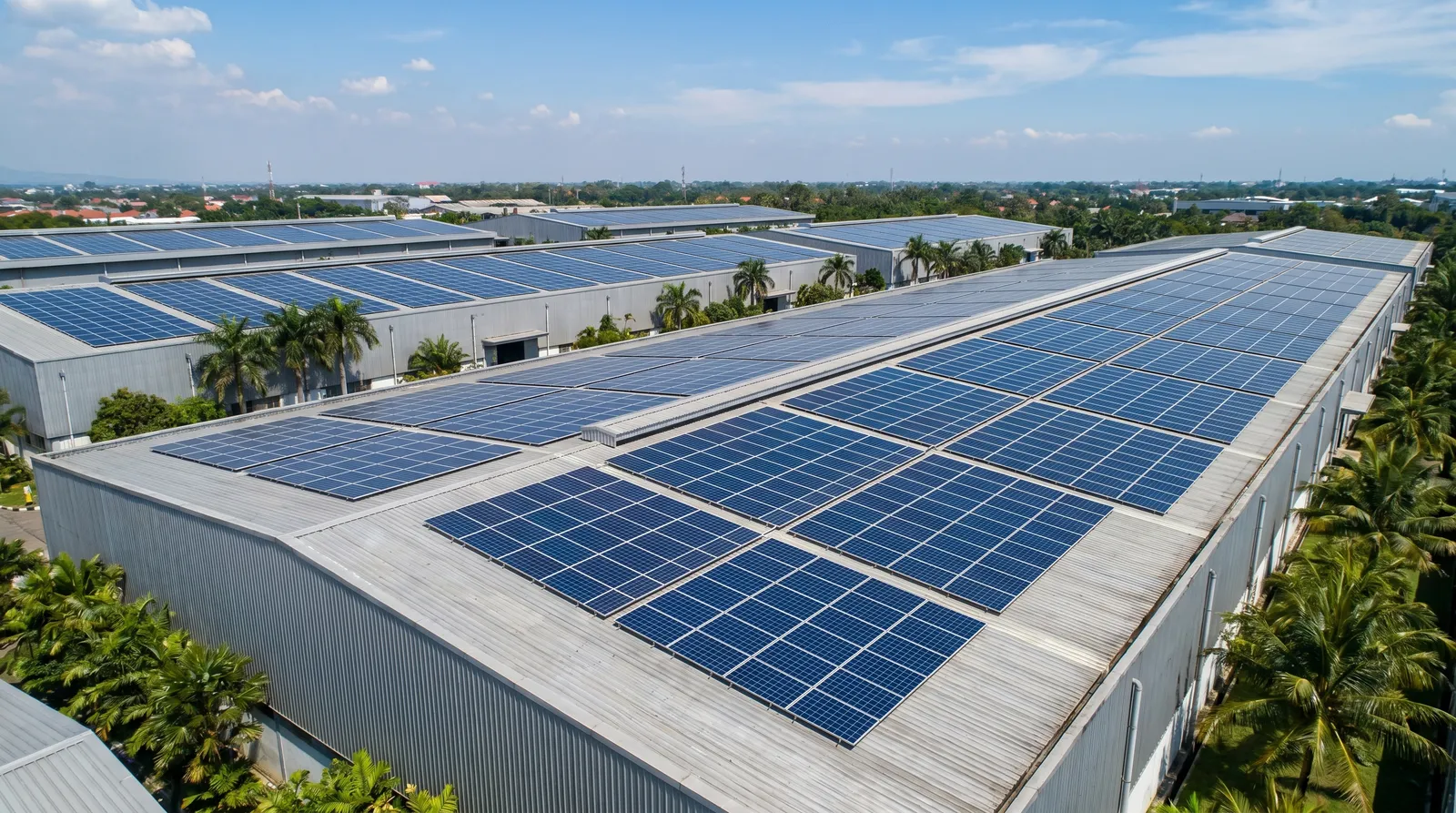
Commercial rooftop solar panels have become the default power upgrade for Indonesian factories, warehouses, shopping malls and distribution centres sitting on large, under-used roof area. A steel or concrete roof over a production hall receives more sunlight in a day than the building below it can use in electricity — turning that idle surface into a power plant is now one of the fastest-payback capital projects an industrial or commercial owner can approve. This page sets out how a commercial rooftop system is sized, what it costs, how PLN's net-metering rules apply, and the stages we run from the first site visit to switch-on.
What counts as commercial rooftop solar
Commercial rooftop solar sits between small residential arrays and utility-scale solar farms. It covers the roofs of manufacturing plants, cold-storage and logistics warehouses, shopping malls, hotels and office buildings — any facility where daytime power use is high enough to absorb most of what the panels generate. That daytime-heavy load profile is exactly what makes commercial solar economics stronger than residential: almost none of the output has to be exported cheaply to the grid. Most projects use Tier-1 monocrystalline solar panels at 550–620 Wp per module, chosen for high efficiency on space-constrained industrial roofs.
Typical system sizes: 100 kWp to 3 MWp
There is no single "standard" commercial system — sizing follows the roof and the load. Smaller workshops and mid-size warehouses typically start around 100 kWp, while a large factory compound, a distribution hub or a multi-building industrial estate can carry 1–3 MWp of rooftop capacity or more. As a rule of thumb, 1 MWp of rooftop panels needs roughly 5,000–6,000 m² of usable roof area and produces around 1,300–1,500 MWh per year at a typical Indonesian site. The table below scales that ratio across common commercial sizes:
| System size | Approx. roof area | Approx. annual generation |
|---|---|---|
| 100 kWp | 500–600 m² | 130–150 MWh/yr |
| 250 kWp | 1,250–1,500 m² | 325–375 MWh/yr |
| 500 kWp | 2,500–3,000 m² | 650–750 MWh/yr |
| 1 MWp | 5,000–6,000 m² | 1,300–1,500 MWh/yr |
| 3 MWp | 15,000–18,000 m² | 3,900–4,500 MWh/yr |
Rule-of-thumb figures — actual generation depends on roof orientation, shading and site irradiance, confirmed during the site survey.
On-grid systems and PLN net metering
The large majority of commercial rooftop installations in Indonesia are on-grid: connected directly to the PLN network with no batteries, which keeps upfront cost lowest and payback fastest. These systems connect under PLN's rooftop solar framework set by ESDM Regulation No. 2/2024: for new systems, surplus exported to the grid is no longer credited against the PLN bill, and connectable capacity follows quotas published per PLN grid system alongside your contracted load (kVA). That is why we design for self-consumption or zero-export from day one. Registration and the technical connection application are handled as part of the EPC scope, and — critically — we size the array to your daytime load rather than to the full roof area, since an over-sized system just exports more energy at unfavourable terms and lengthens payback. Facilities with frequent grid outages or high demand (kVA) charges sometimes add battery storage in a hybrid configuration for backup and peak-shaving.
Payback under industrial and business PLN tariffs
Industrial and business PLN tariffs sit well above subsidised residential rates, and because commercial loads peak during the day — exactly when the panels produce — self-consumption is high. That combination is what drives commercial payback to a typical 5–8 years, versus much longer for a home system. With a 25–30 year module performance warranty, the remaining 17–20+ years after payback are close to pure savings, which is why project IRR on a well-sized commercial system usually runs into double digits. Current per-kWp benchmarks by system size are on our pricing page.
Financing: capex ownership vs PPA
Two financing routes cover most commercial projects. Under capex, you pay for hardware and installation upfront and own the system outright — the simplest structure, and the one that captures the full savings once payback is reached. Under a power purchase agreement (PPA), a third party finances, owns and maintains the rooftop system, and you simply pay for the electricity it produces — typically at a discount to your PLN industrial tariff — with little or no capital outlay and no balance-sheet asset to manage. Capex tends to win on total lifetime savings; a PPA suits businesses that would rather keep solar as an operating expense. Which model fits is usually clear once the feasibility study has real numbers on the table.
From site survey to switch-on
We run every commercial rooftop project through the same five stages, whether it is 100 kWp or 3 MWp:
- Site survey — roof condition, structural capacity, shading, orientation and your PLN bill / load profile.
- Engineering design — single-line diagram, panel and string layout, inverter sizing and permit documentation.
- Supply & installation — Tier-1 panels, inverters and mounting structures delivered and installed by trained crews, in parallel with normal operations.
- Commissioning — electrical testing, PLN grid connection and inspection, and verification against the design yield.
- Operation & maintenance — production monitoring, periodic cleaning and inspection through the system's working life.
For 100–500 kWp rooftop systems, installation itself usually takes 3–6 weeks once design and materials are ready; MWp-scale projects run longer. See our EPC services for the full turnkey scope.
Maintenance in a tropical climate
Indonesia's climate means dust, heavy seasonal rain and high humidity, but upkeep is still light: periodic module cleaning, an annual check of connections and inverters, and real-time monitoring that flags a performance dip before it costs meaningful output. Sites near dusty roads or with high particulate output — cement, woodworking, aggregate — need more frequent cleaning, since a layer of grime can measurably cut yield if left unchecked. A properly maintained system typically still delivers 85%+ of its original capacity by year 25.
Where we install commercial rooftop solar
We design and install commercial rooftop solar across Indonesia's main industrial and commercial hubs, including Jakarta, Cikarang, Karawang, Tangerang, Bekasi, Surabaya, Semarang, Bandung, Medan and Makassar. For the full technical picture on components, batteries and choosing a contractor, see our complete factory rooftop solar guide.
Send your roof area and monthly PLN bill via WhatsApp — we reply with a capacity estimate, annual generation and an indicative payback, free of charge.